Sunday, June 13, 2010

HELPING OUT


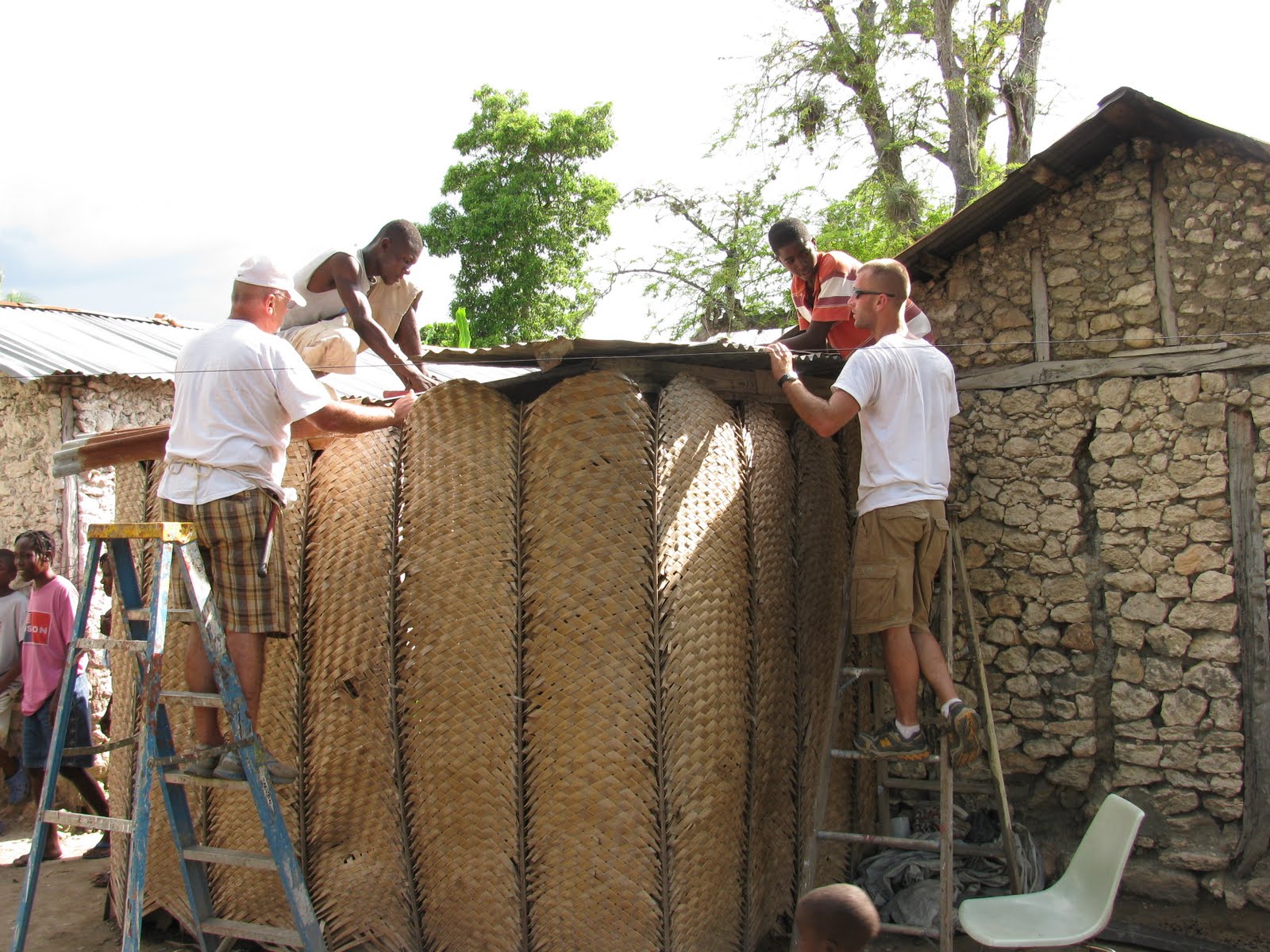
Here at Borel we have two young men who work for us who are deaf mutes. Their name are Dukenson and Phileas. I know I have the spelling wrong but that is how their names sound phonetically. They grew up here in the community and I first met them when I worked here for several months in 2002, they were probably 14-15 years old and would show up each day to help me with whatever I might be doing that day. After I left here a COG mission team arrived and took them on as a ministry outreach. They gave money to send them to Port au Prince to learn to sign to learn a trade and for Dukenson to read and write. Eventually they came back to Borel to live. Last year when I came back to Project Help to be director I gave them jobs here in the compound. They are good workers and show up every morning at 6:00 to start work. They would often tell me in sign about their house and how the roof leaked. Now since we are in the rainy season we went to look at their small one room abode that they call home. The team decided to take a day to put on a roof that doesn't leak. Everyone agreed this was a very rewarding project. Yet to describe how pleased and proud they were about are willingness to help them is beyond my writing abilities but believe me it is a cherished memory that will last a lifetime.

Thursday, June 10, 2010

GETTING A MAKEOVER


Our Project Help compound at Borel has been in existence since 1967 . Some of the buildings we built during our first five years others were built during the years American Fruit Company held ownership from 1920's to 1940's. Though several of the the houses have been torn down for construction of other building five of the former mission houses still exist. The largest house though built as a home for the Jim Wallace family in the late 60's now serves as the main guesthouse. The house I live in has at times over the last 8 years served as the missionary house or a guesthouse. Three of the other houses range from livable to needing a serious makeover. The fifth house which is in the worse shape we have at times considered tearing down but since it's still I think we can find a use for it.
With new missionaries arriving soon we are working hard to prepare a nice family home for them by Jan. It is my hope we will recruit a few more missionaries to help with the abundance of work at hand in the coming months and years ahead. If you read these blogs you know that we are embarking on a new path as we refocus and direct our work here. With the existing medical ministry and the new agriculture, community development and micro loans work we are planning. The Borel compound will become once again a hub of activity. most of our teams coming our helping us give the compound a new look and bring many of the unused buildings back to use. We will have one of the houses finished later this year for the Snyder family. Earlier this year we converted the old butcher shop to a mission team work shop. The poultry barn is planned to become a tilapia fish rearing facility. The original mission dorm may become four small apartments for our visiting agriculture experts and short term volunteers. The present guesthouse is in need of some serious updates to provide more of a guesthouse appearance than a ranch house style. New rules are being implemented for our workers and daily visitors, tighter regulation of the day to day operation will soon be forthcoming to better control how the facilities function. These things don't happen over night especially in Haiti but progress is on the way. Teams this week have been cleaning up much of the junk to be disposed of at a scrap yard in Port au Prince and trash is being cleaned up to haul to a land fill. A new incinerator and trash holding area are being built . A new security building that all visitors must pass through will be built before the end of the year. I'm looking at new infrastructure to make things such as communications, water and electricity more dependable. We have already installed a smaller more fuel miserly generator and battery inverter system for the mission houses and more dependable and quicker Internet and phone service. I'm looking at locating a central dining and cooking area in the bottom of the LDTS building as better than having it located in the guesthouse where it is crowded, hard to clean and attracts rodents. Instead of each missionary having a separate fully equipped kitchen they eat together and only have a small fridge and microwave or small apartment stove in their houses. These are all plans that may be coming in the months ahead, some are being implemented as each new team arrives to help out. An extreme makeover maybe not but a makeover for sure.

Tuesday, June 8, 2010

ACTS TEAM


Two weeks ago we had a group here from the University of Findlay. They did some work projects for us but mostly they came to do ministry work. This included showing the Jesus film at 3 locations. On the next to last day they visited the refugee camp where they entertained the kids with some skits and songs.

Monday, June 7, 2010

TEAMS, TEAMS AND FAMILY


It has been very busy for me here in Haiti the last 4 weeks what with teams every week and now the next two weeks I will have multiple teams. Last week I caught a cold and sore throat and still feel lousy what with the awful heat we are having . Last week my wife joined me and brought our daughter and granddaughter, Alysia and Whitley, for them it is a first visit but probably not the last. It is always good when families get to enjoy a mission trip together and one of the things we like to promote. Two of our team members have traveled with their son and daughters on a combined mission team from Ohio and Pa. Missions impact lives not only for the people in the countries they go to but they shape the lives of those who come. I receive letters and talk to many so many who are living proof of it.

In a way it is good that my daughter and granddaughter can be a part of a mission team experience. Yet I hope when they can come again that we can have more than the 2 days we had this time just as a family. We tried to make the most of those 2 days by having supper and swimming first evening at Club Indigo . The next morning we spent time with Dr. Kerry and Joy Reeves who we consider some of our closest friends here in Haiti. Their kids enjoy having my wife Shirley as a surrogate grandmother here in Haiti. It was great that Alysia and Whitley could meet them. In Haiti you make the most of good friendships not only for companionship but for someone you can count on when you need to.

Thursday, May 20, 2010

2011 PHASE 2


(captions T to B) Haitian bee hive, field we may lease & new irrigation canal


WHERE THERE IS NO VISION THE PEOPLE WILL PERISH

Last week I spent four days here at Borel with the advance team from Mt. Olive College. We drafted a proposal for a partnership for working together to advance agricultural here in the Artibonite valley and even in the mountains beyond. I shared the first phase of that vision that we hope to start as early as September this year. In 2011 we would like to take lease options on some of the farm fields that lie to the back of our compound. One exceptional piece of land has a new irrigation canal going through the middle of it and one irrigation ditch borders one of the boundaries and a third irrigation ditch crosses at another point. Land like this can grow 3 crops a year. A typical rotation is rice, then corn and rice again, other crops that may be grown by some of the farmers are sweet potatoes and beans. The farmers know that it takes fertilizer and nutrients to grow exceptional crops but for lack of money most can't afford to use them. The field work is mostly still by hand labor with hoes and picks their are a few large rototillers being used and a few small tractors with tillers or disc plows. The farmers usually start at dawn which is around 5:00 this time of year and work till 5-6:00 pm when it starts to get dark.

The goal of us leasing farm land is to promote new techniques, crops and practices. Having land out along side other farmers with our crops in view we hope will demonstrate and convince others to try what we are doing. We will be hiring farmers to help work our fields which will also give employment to some in this area. They will also be a voice or good advertisement for promoting what works as we experiment. The crops we produce will be offered at wholesale to area vendors to sell in many of the area markets in the valley. It is hoped that at some point we can organize a small cooperative among our neighbors and make our equipment available to them. We would make the equipment available with our operator to work in their fields for a small fee to cover wages, fuel and maintenance costs. To make it possible for them to change to better agricultural practices we will being offering small micro finance loans. I will talk about this in the next blog.

Sunday, May 16, 2010

OUR VISION FOR 2010 AND BEYOND


FUTURE TILAPIA FACILITY

In my next several blogs I would like to give a brief outline outline of the vision that is starting to unfold for us in the Project Help-Haiti Partnership. It has always been my belief that it is often the small to medium size organizations that get the majority of the work done on the mission field. That isn't to say that the big boys don't add a significant contribution to what gets done, I have great admiration for the efforts of Samaritan's Purse and World Vision's efforts here in Haiti. Yet it is organizations like ours who have established through a long view approach to planning and transformation a grass roots base of support. This has allowed us to acquire local and national acceptance and respect as part of the communities where our multi-site operations are located. It is this long term commitment and longevity (1967) as a government recognized mission organization that has allowed us to be just as successful maybe even more so than the big operations who move on to the next disaster and media hot spot so quickly.

Another reason we can hope for success here at PH-H is that we have recognized the need for building partnerships inside and outside the country. This is allowing us to go outside our traditional Church of God denomination to build our funding, our manpower and our expertise needs. This has been so evident as we receive inquiries from organizations, denominations and individuals who want to partner with us in our efforts here in Haiti. Several of these inquiries have now moved on to developing partnerships like that with the Original Free Will Baptist denomination , Harvest Connection and Mt. Olive College.

It is hoped that by as soon as August we will be starting Phase 1 of our agricultural project with these partners. The plan for 2010 is to develop a Tilapia farming enterprise by building a series of 4 x 12 foot concrete tanks in the unused 45 x 120 foot former poultry barn. Some very new technology that is having great success in Asia will be applied in this operation. One of these is the application of what is called the NANO BUBBLE aeration system. This new technology also has great potential in water purification and keeping our food sources safe. The fish we would raise through this new technology would grow quicker (to the market in less time) and have less mortality than the present methods. Our fish would be available for sale from our farm to entrepreneurs at wholesale so they can market them as fresh fish in the local markets and to processors who would sell them as frozen fish in grocery stores.

The nutrient rich waters from our tanks would be used as a source of fertilizer in our demonstration test plots, our gardens and our shade houses where we start vegetable seedlings and nursery stock. We also have proposed the construction of a hydroponic greenhouse where vegetables will be grown without soil in nutrient enriched water.

This is the vision we have for agricultural projects that we hope to start implementing yet this year. In the next blog I will outline the plans we have for implementing in Jan. 2011. This is a massive project and certainly one that PH-H could have never attempted without partners . In late June we will be gathering at a summit at Mt. Olive College in N. Carolina to present our vision at an open forum in hopes to take this from the visionary / planning stage to reality.

Friday, May 14, 2010

WHERE THERE IS NO VISION THE PEOPLE WILL PERISH


On Monday I arrived back in Haiti after a five week absence to return home for business, visits and rest. The rest never happened as I found myself constantly busy with phone conversations, e-mails and travel. One of my travels took me to N. Carolina to meet with Harvest Connection a mission outreach of the Original Free Will Baptists denomination and also the agri business school of Mt. Olive College. This week it was their turn to travel as they sent an advance team to Haiti to draft a partnership proposal between themselves and Project Help-Haiti. The team consisted of two college professors from the Ari Business center of Mt. Olive college Dr. Peter Appleton and Dr. Phillip Hamilton. Their task was two fold** to identify areas of cooperation between PH-H , the MO College and the Original Free Will Baptists ** to prepare a proposed partnership between PH-H and MO College in agriculture at our Borel Facility. This proposal plan will be presented to the Original Free Will Baptists at their annual convention at Mt. Olive College this Wed. evening 5/19 and then at an open to the public summit at Mt. Olive College on June 28th. It is possible that we will be moving forward to implement some of areas of the agriculture plan as early as this Fall Sept. --November. The rest of the plan will move forward in 2011 as we start up the field operations.