Sunday, August 14, 2011

DRIVING IN HAITI


One of the frequent questions I'm asked from visitors to Haiti is about driving. It is pretty obvious that driving here is different than what we learn and experience in the U.S. Here are a few samples: "how long did you live in Haiti before you started driving" I'm not sure but the rational for that question is probably based on fear of the unknown. It appears that there are no rules (there are), no protocol (there is) and no common sense (debatable). I was once told by a Haitian friend that Haiti has very good laws but no one observes them. That is a pretty accurate assessment. It starts at the top and works it's way down that if that guy can get away with it so can I, that is especially so with driving, because on the road everyone is in a sense equal it just depends on who has the most nerve and the most to lose.

Another popular question is "does it take long to learn how to drive here in Haiti?" I guess that depends on what your skill level was before you got here. If you are a competent driver in the U.S. you will do fine here but success at driving here comes from two conflicting concepts. 1. You must always be alert for the unexpected Haitian drivers are inpatient so you never know where they are at or might do. They don't easily accept that they should be slowed down by or waiting in line because a vehicle is ahead of them. So they pass you on the left or the right, in a ditch or on a sidewalk, on a hill or a curve, they have no fear of oncoming traffic always believing that the other driver will slow or swerve to let them get around. 2. The other concept is if you give another vehicle behind you or beside you an advantage of even a few feet between you and the vehicle ahead they will cut in and squeeze you out. So city traffic and traffic jams become a game of chess in seeing who can out maneuver the other guy.

Another question I get, "Is it difficult to resume driving normal when you go back to the U.S?" Gosh that is a tough one but I would say not really my speed here in Haiti never exceeds what is legal in the U.S. We do have traffic lights at most major intersections in Port au Prince and even two in St. Marc. I don't pass on curves or hills in either country. In Haiti my wife never says a word about my driving though she often seems apprehensive in the states as well as vocal, doesn't make sense to me, as we are in more danger here. My last team was from Calif. and I have a certain image of Calif. drivers as not timid but they were amazed that I passed a police vehicle that was ahead of me. They embellished it just a little by saying "only in Haiti can you pass a police car, with double yellow lines on a curve." I didn't actually do those last two but if I had I wouldn't have been stopped or ticket. Several years ago I had a Royal Canadian Mounted Policeman here for two weeks as we drove around he made the comment that he would have filled a citations book in one hour if he was on duty here in Haiti.

So what is it about driving in Haiti that amazes people? It is chaos in the city traffic jams. The streets are narrow and full of people walking, standing, riding bicycles and moto's. There are goats, cows and horses on the streets even in the capital. The public transportation of Taptaps and old yellow schools buses are jammed with people and commerce. People even ride on the tops of buses or hang on the back of them. I think for most visitors it is their first dose of culture shock but given time it becomes the norm for those of us who live here. It certainly is a good topic of conversation as we bring visitors out from the airport. SJM

Monday, August 8, 2011

PARTNERS IN THE JOURNEY


Back in 2002 when I started GAP Ministry I used the phrase "Partners in the Journey" on some of our brochures. I borrowed this slogan from an old advertisement for a canoe company. I intended this slogan to be two fold for my organization and those who worked with us: we would be a "sharer" and a "participant" with those who might choose to use or work with our mission. Also we felt that those who ventured out to serve the Lord in missions would experience a very special and privileged "partnership" with God in their mission journey.

Probably we have all heard the saying "life's a journey." Some of us are given a little more lengthier journey than others but even so life is short. Without God as your partner your life's journey is a wasted trip! But even with God by your side you shouldn't expect that journey to be a leisurely stroll through the park or along the beach. God calls us all somewhere for some purpose and I'm convinced that if your where God wants you it may not be easy but it will be rewarding and enjoyable.

Journey comes from the French word journee (a day) so one meaning is a day's work or travel, or passage from one place to another. A journey in itself requires movement or steps and to get the most out of our journey we need to move out of our comfort zone. A challenge from a former pastor to our congregation was that we each imagine something that would be out of our comfort zone and attempt to do it. Mine was a mission trip out of the country and that ended up being Haiti. That difficult first step has become my journey the last 12 years, yet at some point the journey may take a different path if it does I'm ready to see where it leads. SJM

Sunday, July 31, 2011

WHEN IT RAINS IT POURS


RAIN, RAIN AND MORE RAIN


We have all heard the old saying "WHEN IT RAINS IT POURS" in more ways than one that is true with Haiti. If you don' live in or have visited the Tropics, S.E Asia, India, Bangladesh, the Rain Forests or our own N.W. United States you probably don't have a comprehension of the amounts of rain that can fall during each day of the "rainy season". I'm from Indiana where it can rain heavy in the Spring before and during the planting season, then as often as not be too dry during the Summer growing season, then be rainy during the Fall harvest. Even so I'm totally amazed at the amount of rain Haiti receives from May through Nov. and you can double that if the Hurricanes are hitting Haiti.

It has been raining pretty regular since my return to Haiti ten days ago but the last several days the rains have flooded the streets of Liancourt and yesterday St. Marc. Yesterdays rain was intense with near gale force winds and rains making it very difficult to see if not drive. The good thing is such intense weather conditions are about the only thing that make Haitians drive somewhat cautiously and slow down. I met many a vehicle yesterday with flashing caution lights on.

St. Marc streets were running with chocolate colored water yesterday often 12 inches deep. Where the steep side streets run down from the surrounding hills they look like mountain streams rushing to get to the ocean but once they hit the perpendicular main street it becomes a river of water.

The thing that gets me is the difference in cultural attitudes about rain. Yes kids will be kids anywhere and love to play in the rain and run through water puddles. Though of course in our culture we yell at our children " get in this house you better not be getting your clothes all wet", in Haiti it is not that way at all. People walk nonchalantly about as if they don't even notice it or for sure that they accept and enjoy it. Flooded soccer field serve as a new form of water soccer. Young men and women go out jogging on the streets a form of shower while you exercise or maybe visa versa. Possibly they may even take along a bar of soap, but not sure about that. Adults and children get underneath water spouts where the water comes off roofs and bathe. Young people, usually teens and twenty year old's dance in the streets or along the highways. This is all contrary to my way of thinking in that when it rains you get inside or protect yourself with rain gear or an umbrella. The other day as as I drove up to DeChapelle in the rain a lady was walking down the road with an unopened umbrella balanced on top of her head!! Now that may sound like an oxymoron to us from another culture but more often than not I see umbrellas used more to keep the sun off women and babies than to deflect rain. Contrary to what some people may think Haitians know when it's way too hot thus they may desire to thwart the heat from the suns rays rather than the coolness of the falling rain. "God's rainbows come in many colors and so do the people He created and loves". SJM


Wednesday, July 20, 2011

NEW WEBSITE


THANKS TO THE HIGHVIEW COG TEAM WHO REPAIRED THIS MOUNTAIN CHURCH
Our new website should be launched today and hopefully be another tool for us to educate and communicate to all those who have an interest in Haiti and our work there. We have added some new features and kept some of the old but our intention is that all of the different ways we communicate are at one location.

I started doing updates about a year ago and sending them out to many of my friends and readers. They in turn would often share with their friends who would request to be added to my update list.The PH-H updates, blogs and newsletters are now available to anyone who has a computer and our website address. We have also added the blogs of several other organizations working in Haiti with PH-H and those of some of our other Church of God General Conference (CGGC) fellow missionaries who work in other countries. Since I write the PH-H blog and update my intention is that the blog be more of a personal account of my life not only in Haiti as the PH-H director but back in the states. I hope to post to it every week to 10 days. The updates will be more what is actually going on with the PH-H ministries, projects, our teams, staff, missionaries and my PH-H work in Haiti and the U.S. on it's behalf. I hope to do as many as 3 updates a week especially during my stays in Haiti which typically are about 8 months every year. When I'm back stateside attending to mission business and some R&R there is still plenty to write about. Another form of communications we use is Facebook where you can often get several short snippets and pictures of what is going on each day in Haiti and also follow some of what our other missionaries in Haiti are doing.

We also have added plenty of contact info and how others can join with our Project Help Team to impact the Haitian communities where we work and live. If you want to learn even more you can go to our CGGC website to learn about all the other countries that Cross Cultural Ministries has missionaries working in. Check out our earthquake video and we have a another brand new video we will be adding soon. I leave for Haiti on Friday morning so stay tuned to our new website to follow what is going on. In God's Love, SJM

Saturday, June 11, 2011

THE BEAUTY OF HAITI

My Highview Church of God team
from Lancaster, Pa. was scheduled to depart at 2:25 pm yesterday. Normally if teams are at the Borel campus and they have an afternoon flight we drive directly from here for the 2.5 hour trip. If their flight is in the morning we take them to Pierre Payen the night before. Our plan was to have a leisure breakfast then hit the road at about 9:00 am so we could arrive at the airport at around noon.

Up here in the Valley people like to protest about whatever is their latest problem. Yesterday it was the lack of electricity. We have a hydro electric plant about 6 miles down the road on one of the canals . So the locals put rocks across the road to make a blockade , not just one row but about 20 rows in a one mile stretch, to prevent employees getting to the power plant. After determining that it would be impossible to get through I decided to take the longer route I had always wanted to try up and over the mountains.

Route Verettes the road that passes through Borel climbs up through the Le Artibonite valley following the meandering river into Mirebalais. This is a very scenic route with the road curving and climbing the grade to a higher elevation. Clear mountain streams rush down from the surrounding mountains to join up with the muddy river water headed for the coast.

Once the road gets to Mirebalais you get on route 3 that crosses the Central Plateau going from port up to Mirebalais, Hinche and on to Cap Haitien. We headed East on 3 which is a several thousand foot climb by switchbacks up over the mountain range ringing the Plateau area. As we curved around the last switchback and crested the summit we could gaze down on the Plaine de Cul , the flat lands surrounding Port au Prince.

The traffic as always was bumper to bumper as we took route 1 through the suburbs of Bon Repon and Cazale to the airport. Having a patient attitude and air conditioning helps , I had the first but not the second. Anyway we pulled into the airport at 12:00 on schedule and met up with one of our drivers who brought in the rest of the team luggage from our other compound at Pierre Payen. I think most of the team were awe struck by the beauty of this route through the mountains and captured it on camera to share with others back home. I know I will be passing this way again maybe not to take teams to the airport but just to enjoy the beauty of Haiti. SJM BlogBooster-The most productive way for mobile blogging. BlogBooster is a multi-service blog editor for iPhone, Android, WebOs and your desktop

Sunday, June 5, 2011

INTO THE MOUNTAINS


Last year's earthquake damaged several of our mountain churches as well as completely destroyed our church in Port au Prince. The churches in the mountains pose several problems
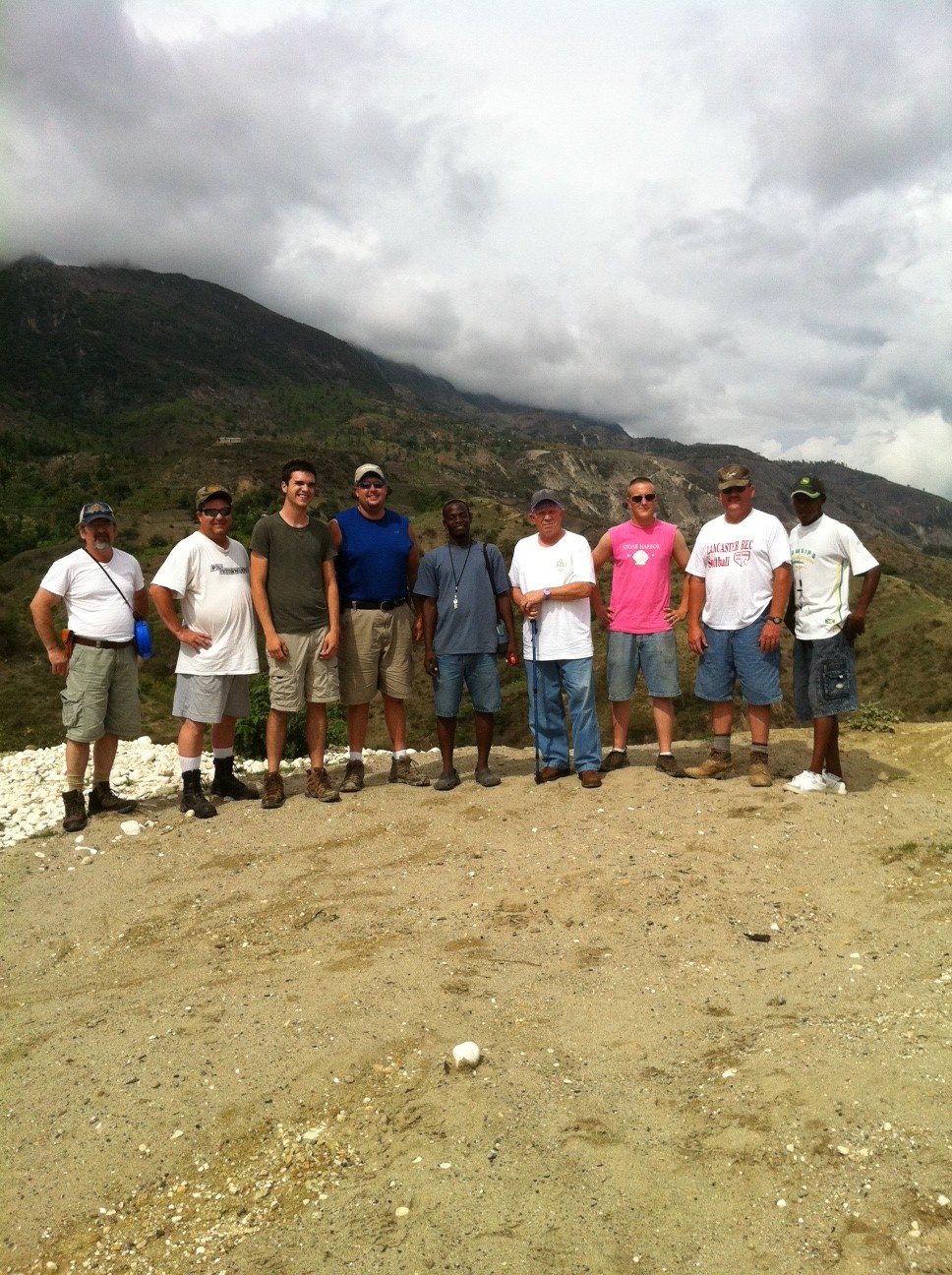
1. getting the materials and equipment up to the churches and 2. finding teams willing to rough it by staying in the mountains and get the job done. I got a call late last year from Lancaster, Pa. from a young man wanting to lead a team from his church the Highview Church of God. Saturday I picked up his seven member team at the airport in Port au Prince. This afternoon after church and lunch at our guesthouse at Pierre Payen we took them up to the trail head and dropped them off . Several adults and children from the village of Bourne came down to help carry their supplies up. Watson Joseph one of our employees who works with our visiting teams here at the Borel campus has taken on the additional task of leading these teams that come to work in the mountains. The teams packed in their sleeping gear , water purification bottles, supplemental food, hygiene, extra clothes and tools. We sent up food supplies and contracted locals to cook two meals a day for them. The biggest obstacle is the weather it has been raining everyday now for 6 days. This could slow them down but excitement was high as I pointed out the distant village on the side of the mountain. In my years here in Haiti possibly one the biggest advancements besides internet is cell phones. This gives me the advantage we didn't have years ago to be in contact with our teams and keep them supplied with materials, food, health care and bring them out when they finish. It seems a trend in many of our teams has been to take on these type of more difficult projects we are grateful some our called to a HIGHER adventure than others, God bless them. SJM

Thursday, April 14, 2011

LIFE IN HAITI

FLIP FLOPS AND OCTOPUS APPETIZERS

Last Friday as I was in my home at Borel, Haiti preparing to get ready to fly home on Sunday morning for a few weeks of rest, meetings and speaking engagements I had a visitor knock at my door. This is a typical everyday occurrence that goes with my director's job and it always intensifies as my departure date approaches. Loveline our Haitian daughter came to notify me I had someone who wanted to talk to me, this usually means one thing someone is there to ask me for help with something. Much to my surprise though this person had come to bring me a gift or actually gifts.

My Haitian visitor who was a rather short, thirty something diver was from a beach area on the N.E. side of St. Marc. This is where we sometimes take our teams to swim on Sunday afternoons. Haitians are innovative and resourceful and he made his living by diving off shore for live conch
( lambi), lobster and occasionally octopus. The conch our doubly valuable because he can sell the shells as well as the meat that is inside to those who come to swim at the beach area. He called himself a diver and a chef. He wanted to inform me that he had traveled from St. Marc to prepare us Project Help missionaries a meal out of lambi and octopus.

It is not unusual for Haitians to bring or give you edible gifts, even live ones. I was once given a live goat for something I had done to help out a relative of an employee. Immediately after the goat was butchered I was informed my cook was preparing me a goat brain sandwich. I often order lambi at Haitian restaurants where it is part of a delicious Creole sauce. Once in a while I buy it raw from street vendors who preserve it in a spicy pickling sauce and put it in an old rum bottle from which they dispense it. I had never eaten octopus put I'm not squeamish about food nor how it is prepared and seeing how I was on my own for lunch that day it was a much welcomed gift. The other missionaries were in St. Marc buying groceries and were going to eat at a restaurant above the Deli Mart.

As I watched him prepare my ocean treat I learned the details that had brought him 30 miles inland to cook me a meal. The Sunday before our team and some of the missionaries had gone to the beach where he makes his living. Now normally we can drive to the beach but that day a truck had broken down on a very steep section of the beach road making it difficult to get pass that vehicle. So the transport truck was parked and the group walked to the beach as we had often done before the road was improved. One of the team members was wearing flip flops
(not good for hiking in Haiti) and as often happens the flip flop fell apart. It seems our visiting diver happened along and offered his foot ware to the barefoot team member and out of gratitude some money was exchanged. The diver wanted to give a little extra in return for the money he had received and as I said earlier Haitians are very resourceful people. So he also didn't miss the chance to give me a short sales pitch of how he could do this as a service for our teams. I wouldn't be surprised if you come and spend a week with us you might be eating some conch and octopus appetizers. SJM